
Research led by Zak Page, associate professor of chemistry at the University of Texas at Austin, has introduced a new 3D printing method that allows a single material to be fabricated with sharply different mechanical and optical properties. Developed in collaboration with Sandia National Laboratories and other U.S. national research laboratories, the technique enables the creation of realistic replicas of complex structures, including models as intricate as the human hand.
Commisso, A. J., Nagel, E. M., Kiker, M. T., Recker, E. A., Bischoff, A., Holzmann, M. J., Fowler, H. E., Pham, M. N., Nguyen, C. P. H., Baca, E., Villanueva, H., Almada, N. T., Mason, K. S., Jolowsky, C., Suman, G., Fritzsching, K. J., Kaehr, B., Schwartz, J. J., Appelhans, L. N., … Leguizamon, S. C. (2026). Lithographic crystallinity regulation in additive fabrication of thermoplastics (CRAFT). Science, 391(6784), 511–516. https://doi.org/10.1126/science.aeb3637
Additive manufacturing has advanced rapidly in recent years, but producing objects with both rigid and flexible regions has remained difficult. Most multi-material printing approaches rely on expensive printers, complex resin systems, or multiple materials that bond poorly at their interfaces. These limitations are especially apparent in applications such as medical training models, where inaccurate mechanical behavior can reduce realism and usefulness.
Zak Page, associate professor of chemistry at the University of Texas at Austin stated,
“We can control molecular level order in three-dimensional space, and in doing so, completely change the mechanical and optical properties of a material. And we can do that all from a really simple, inexpensive feedstock by just changing the light intensity. It’s the simplicity at the heart of it that’s really exciting.”
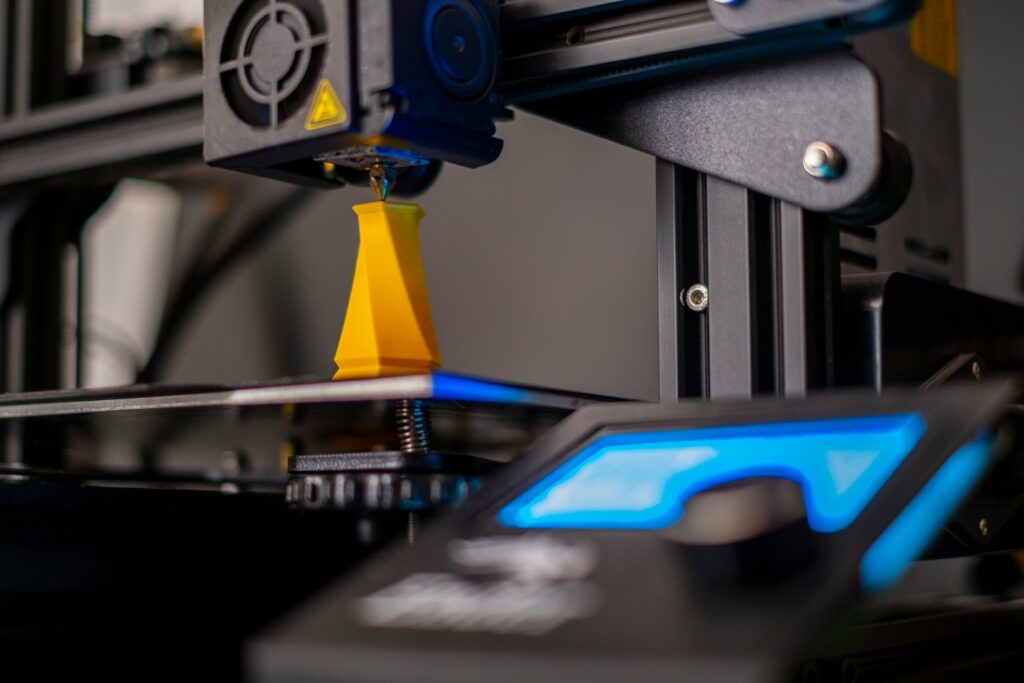
The CRAFT method addresses this challenge by controlling material properties during printing rather than switching materials. Using a standard digital light processing or LCD 3D printer, the researchers project grayscale light patterns into a liquid thermoplastic resin. By adjusting the light intensity at each point, they control how the polymer crystallizes as it solidifies. This process allows stiffness, flexibility, and transparency to vary smoothly across the printed object, even though it is made from a single feedstock.
At the molecular level, the technique alters how ordered or disordered the polymer chains become as they form. Regions exposed to stronger light develop higher crystallinity and become stiffer, while areas receiving lower light intensity remain more flexible. This pixel-level control enables fine transitions between hard and soft domains without the weak interfaces that often occur in multi-material prints.
To demonstrate the method, the team printed a model human hand with distinct regions representing skin, tendons, ligaments, and bone. Each region responded differently to mechanical stress, closely mimicking how real tissue behaves. Similar demonstrations included test bars with alternating stiff and soft segments that stretched sequentially under load, highlighting the precision of the property control.
The researchers suggest that this capability could be particularly useful in medical education. Training models produced with CRAFT could offer a more consistent and accessible alternative to cadavers, which are costly and difficult for many institutions to obtain. Because the method relies on affordable printers and widely available resins, it may lower barriers for medical schools and research labs seeking realistic anatomical models.
Beyond biomedical applications, the technique may also be relevant for energy absorption and vibration damping. Materials that combine rigid and compliant regions are common in nature, such as bone or tree bark, and are known for their ability to absorb impacts without catastrophic failure. Replicating these structures synthetically could lead to new designs for protective equipment, helmets, or sound-damping components.
Related research in advanced manufacturing has shown growing interest in spatial control of material properties, particularly for bioinspired and functional structures. Compared with earlier approaches that required custom hardware or complex chemistries, CRAFT stands out for its compatibility with low-cost commercial printers and its use of a single, simple resin system.
The work also touches on sustainability considerations. While the printed objects are not fully recyclable, the thermoplastic nature of the material allows parts to be melted or dissolved and reshaped, potentially reducing waste compared with traditional single-use prototypes.
The findings, published in Science, demonstrate how precise control over crystallinity during printing can expand what is possible with additive manufacturing. By focusing on how materials form rather than what materials are used, the CRAFT method offers a new route to producing complex, functional structures that more closely resemble those found in the real world.

Adrian graduated with a Masters Degree (1st Class Honours) in Chemical Engineering from Chester University along with Harris. His master’s research aimed to develop a standardadised clean water oxygenation transfer procedure to test bubble diffusers that are currently used in the wastewater industry commercial market. He has also undergone placments in both US and China primarely focused within the R&D department and is an associate member of the Institute of Chemical Engineers (IChemE).