
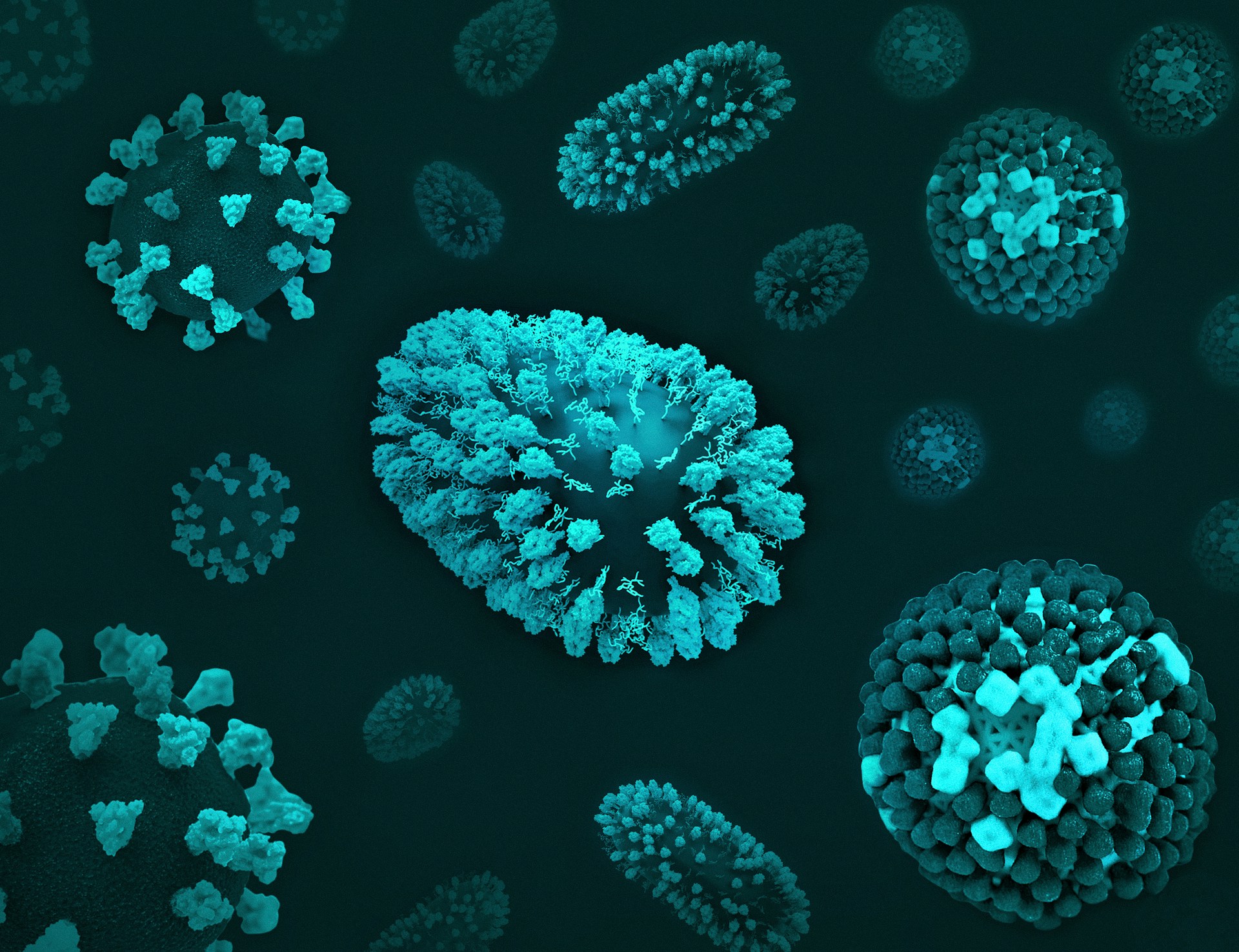

A new study led by Deepak Koirala, associate professor of chemistry and biochemistry at the University of Maryland, Baltimore County, provides detailed insight into how enteroviruses begin replicating inside human cells. The research, published in Nature Communications, examines a molecular interaction shared across a large class of viruses, including those responsible for polio, myocarditis, encephalitis, and many common respiratory infections. By clarifying this early replication step, the work identifies a potential drug target that could be effective against multiple enteroviruses rather than a single strain.
Das, N. K., Patel, A., Abdelghani, R., & Koirala, D. (2025). Structural basis for 3C and 3CD recruitment by enteroviral genomes during negative-strand RNA synthesis. Nature Communications, 16(1), 9293. https://doi.org/10.1038/s41467-025-64376-0
A new study led by Deepak Koirala, associate professor of chemistry and biochemistry at the University of Maryland, Baltimore County, provides detailed insight into how enteroviruses begin replicating inside human cells. The research, published in Nature Communications, examines a molecular interaction shared across a large class of viruses, including those responsible for polio, myocarditis, encephalitis, and many common respiratory infections. By clarifying this early replication step, the work identifies a potential drug target that could be effective against multiple enteroviruses rather than a single strain.
Deepak Koirala from University of Maryland, Baltimore County stated,
“Viruses are so, so clever. Their entire genome is equivalent to about one mRNA sequence in humans, yet they are so effective, why we need to investigate this basic science—so that it can be translated into developing drugs targeting pathogens that cause so many harmful diseases.”
Enteroviruses rely on a small RNA genome that must serve two purposes inside the host cell. The same RNA molecule is used both as a template to produce viral proteins and as a blueprint for copying new viral genomes. Managing this switch efficiently is essential for viral survival. At the center of this process is a structured region of RNA known as the cloverleaf, located at the front end of the viral genome. This region does not encode proteins but instead acts as a control element that helps organize the replication machinery.
Koirala’s team focused on how the cloverleaf RNA recruits viral proteins to initiate genome copying. In particular, they examined a viral fusion protein called 3CD, which combines two critical functions. One part of the protein, known as 3C, is a protease that cuts viral proteins into their functional forms. The other part, 3D, is an RNA dependent RNA polymerase that copies the viral genome. Human cells lack this type of polymerase, so the virus must encode and transport it within its own genome.
Using X ray crystallography, the researchers captured a high resolution structure of the cloverleaf RNA bound to the 3CD protein. This allowed them to directly observe how the molecules interact. Their results show that the 3C domain of the protein binds to the RNA and acts as an anchor point, drawing in additional viral and host proteins required for replication. Measurements from isothermal titration calorimetry and biolayer interferometry further confirmed the strength and stability of this interaction.
The study also resolves a long standing debate in the field regarding how many replication proteins assemble on the RNA. The data indicate that two full 3CD molecules bind side by side on the cloverleaf, rather than forming a single combined unit. Each molecule contributes its own polymerase domain. While the precise reason two polymerases are required is not yet fully understood, the structural arrangement itself is now clearly defined.
One of the most significant findings is how consistent this mechanism appears across different enteroviruses. The researchers examined multiple viral types and found that both the RNA cloverleaf structure and its protein binding behavior were highly conserved. This level of conservation suggests the interaction is essential for replication and unlikely to tolerate mutation, making it an attractive target for antiviral development.
Current antiviral strategies often focus on blocking viral enzymes directly, such as proteases or polymerases. The UMBC study suggests an additional approach: disrupting the interaction between viral RNA and its associated proteins before replication can begin. Because structured RNA elements tend to change more slowly than proteins, targeting this interface may reduce the likelihood of drug resistance.
While the work is rooted in basic molecular science, its implications extend to applied research and drug design. Having a detailed structural map of a shared replication mechanism enables more precise modeling of compounds that could interfere with viral growth. The study highlights how careful analysis of molecular architecture can reveal vulnerabilities that are common across an entire class of pathogens, offering a potential path toward broader spectrum antiviral therapies.
Enteroviruses rely on a small RNA genome that must serve two purposes inside the host cell. The same RNA molecule is used both as a template to produce viral proteins and as a blueprint for copying new viral genomes. Managing this switch efficiently is essential for viral survival. At the center of this process is a structured region of RNA known as the cloverleaf, located at the front end of the viral genome. This region does not encode proteins but instead acts as a control element that helps organize the replication machinery.
Koirala’s team focused on how the cloverleaf RNA recruits viral proteins to initiate genome copying. In particular, they examined a viral fusion protein called 3CD, which combines two critical functions. One part of the protein, known as 3C, is a protease that cuts viral proteins into their functional forms. The other part, 3D, is an RNA dependent RNA polymerase that copies the viral genome. Human cells lack this type of polymerase, so the virus must encode and transport it within its own genome.
Using X ray crystallography, the researchers captured a high resolution structure of the cloverleaf RNA bound to the 3CD protein. This allowed them to directly observe how the molecules interact. Their results show that the 3C domain of the protein binds to the RNA and acts as an anchor point, drawing in additional viral and host proteins required for replication. Measurements from isothermal titration calorimetry and biolayer interferometry further confirmed the strength and stability of this interaction.
The study also resolves a long standing debate in the field regarding how many replication proteins assemble on the RNA. The data indicate that two full 3CD molecules bind side by side on the cloverleaf, rather than forming a single combined unit. Each molecule contributes its own polymerase domain. While the precise reason two polymerases are required is not yet fully understood, the structural arrangement itself is now clearly defined.
One of the most significant findings is how consistent this mechanism appears across different enteroviruses. The researchers examined multiple viral types and found that both the RNA cloverleaf structure and its protein binding behavior were highly conserved. This level of conservation suggests the interaction is essential for replication and unlikely to tolerate mutation, making it an attractive target for antiviral development.
Current antiviral strategies often focus on blocking viral enzymes directly, such as proteases or polymerases. The UMBC study suggests an additional approach: disrupting the interaction between viral RNA and its associated proteins before replication can begin. Because structured RNA elements tend to change more slowly than proteins, targeting this interface may reduce the likelihood of drug resistance.
While the work is rooted in basic molecular science, its implications extend to applied research and drug design. Having a detailed structural map of a shared replication mechanism enables more precise modeling of compounds that could interfere with viral growth. The study highlights how careful analysis of molecular architecture can reveal vulnerabilities that are common across an entire class of pathogens, offering a potential path toward broader spectrum antiviral therapies.

Adrian graduated with a Masters Degree (1st Class Honours) in Chemical Engineering from Chester University along with Harris. His master’s research aimed to develop a standardadised clean water oxygenation transfer procedure to test bubble diffusers that are currently used in the wastewater industry commercial market. He has also undergone placments in both US and China primarely focused within the R&D department and is an associate member of the Institute of Chemical Engineers (IChemE).